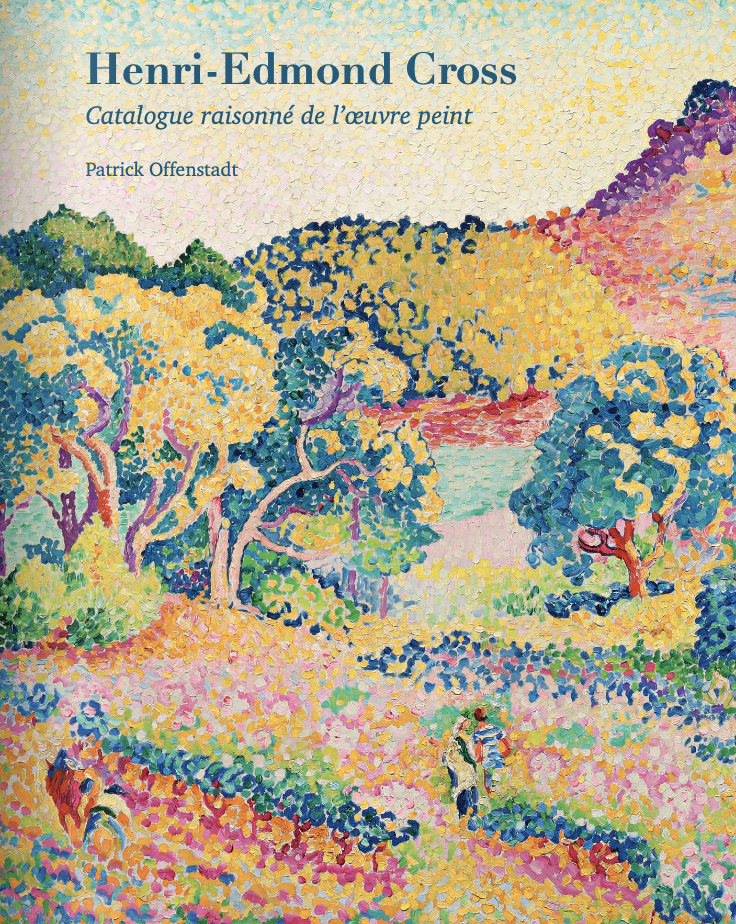
The art and life of Henri-Edmond Cross
Henri Edmond Joseph Delacroix was born in Douai, at 15, rue Jean-Bellegambe. His family had a hardware store there. A cousin of his father saw his talent when he was a child and became his guide. He apprenticed in Lille, with Carolus-Duran and Alphonse Colas.
“Pioneer of Divisionism alongside Seurat and Signac, Henri-Edmond Cross captured the light and vibrant colours of the Mediterranean coast.”
— Galerie Offenstadt · Patrick Offenstadt
For his first exhibition at the Salon of 1881, he decided to translate his surname "Delacroix" into English "Cross". It was so as not to be confused with Eugène Delacroix, and it was an idea of his friend the painter François Bonvin.
At first, Henri-Edmond Cross painted in the naturalistic style. Then he moved closer to the Neo-Impressionist painters. He shared their anarchist political ideas.
In 1893, he married Irma Clare. She was divorced from the writer Hector France and was of British origin. Cross had painted her in 1891 in a portrait called "Madame Hector France", which is now in the Musée d 'Orsay.
From 1896, he worked for the newspaper "Les Temps Nouveaux" by Jean Grave. He gave her drawings, lithographs, and watercolors for the tombolas that helped the newspaper and its publications.
He made a lithograph for the novel "La Gennia" by John-Antoine Nau. It was a particular spirit novel. He then made two more color lithographs. The first was published by Ambroise Vollard in 1897 ("La Promenade"), and the second appeared in the journal Pan in 1898 ("Les
Henri-Edmond Cross — Catalogues Raisonnés & Suppléments
Catalogues raisonnés of watercolours and oil paintings by Henri-Edmond Cross, edited by Patrick Offenstadt, with supplements and digital 3D flipbooks.