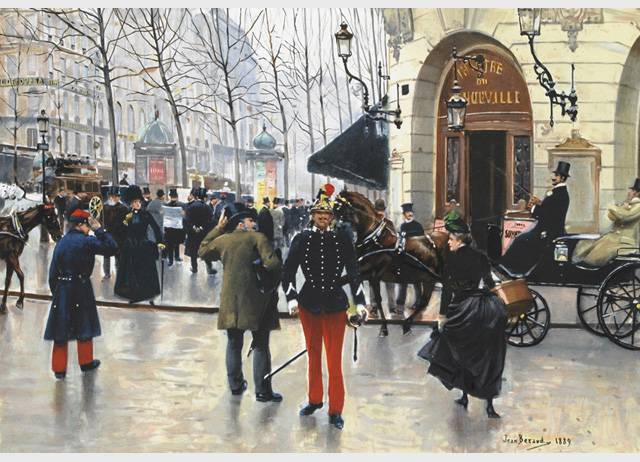
The art and life of Jean Béraud
Jean Béraud was born in St. Petersburg, Russia, with his twin sister Mélanie. His father, who was a sculptor, probably worked on the site of St. Isaac's Cathedral at that time. After his father's death in 1853, his mother, Geneviève Eugénie Jacquin, returned to Paris with her four children.
“A refined and meticulous chronicler of the Belle Époque, Jean Béraud immortalized the vibrant bustle of Parisian boulevards, the elegance of literary salons, and the daily life of his era.”
— Galerie Offenstadt · Patrick Offenstadt
He was educated at the Lycée Bonaparte, then was a student of Léon Bonnat at the École des Beaux-Arts in Paris. He exhibited for the first time at the Salon in 1872. In 1876, he achieved success with his painting "The Return of the Funeral" and, in 1878, he presented "Ballet Scene". He was awarded a 3rd medal in 1882 and a 2nd medal in 1883.
In 1883, he drew an illustration entitled "Le Viveur" for Jean-Louis Dubut de Laforest's play, "Le Rêve d 'un Viveur". This drawing was published in the collection of the play.
In 1889, he was awarded a gold medal at the Salon des Artistes Français and exhibited at the Exposition Universelle in Paris. He became one of the main painters of Parisian life during the Belle Époque.
In 1890, he co-founded the Société nationale des beaux-arts with artists such as Auguste Rodin, Ernest Meissonier and Pierre Puvis de Chavannes, of which he became the vice-president.
He made illustrations for the covers of the Figaro illustrated between 1890 and 1896.
Jean Béraud witnessed the duel between Marcel Proust and Jean Lorrain at Meudon in February
Jean Béraud (1849–1935) — L'Œuvre Peint
Patrick Offenstadt, in collaboration with the Wildenstein Institute, published the definitive catalogue raisonné of Jean Béraud (Taschen). This fundamental monograph catalogues all authenticated paintings and analyses the artist's role in Belle Époque society.